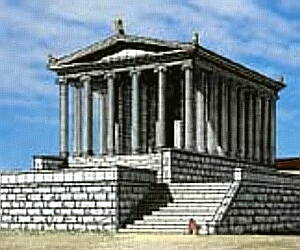
T e m p l e o
f A t h e n a a t M i l e t u s
(Click the image for a full screen view) The Temple of Athena at Miletus
Miletus History
![[Click to enlarge image]](Ionia_tn.jpg)
The Minoans abandoned their colony in Miletus by 1400 BCE and were followed by Mycenaeans from Greece. They were the ones who fortified the city. Mycenaean Miletus was a dependency or ally of Ahhiwaya (Achaea) though its population was mostly Carian. Shortly after 1300 BCE the settlement was destroyed by fire -- probably at instigation of the Hittites who knew the city as Millawanda. The Hittites fortified the city against possible naval attacks by the Greeks. In 1000 BCE the city was captured by the Ionians. The Greek settlers from Pylos under Neleus are said to have massacred all the men in the old city, and built for themselves a new one on the coast. After 687 BCE the city started to be ruled by tyrants and began to settle colonies overseas. Along the Hellespont, the Propontis and the Black Sea coasts it founded more than sixty cities — among them Abydus, Cyzicus, Sinope, Dioscurias, Panticapaeum and Olbia. All these cities were founded before the middle of the 7th century BCE. By the 6th century BCE the city became a maritime empire. In addition to producing philosophers and historians, the city was also famous for its purple dye, its furniture, and the quality of its wool. On the Persian conquest Miletus passed under a new master; it headed the Ionian revolt of 500 BCE, and was taken by storm after the battle of Lade (494 BCE). Darius massacred most of the inhabitants, transported the rest to Ampe at the mouth of the Tigris river, and gave up the city to the Carians. This disaster was long remembered in Greece and made the theme of a tragedy by Phrynichus. The city recovered indeed when the Persians were expelled from the coast in 479 BCE, became a member of the Delian League, revolted against Sparta in 412 BCE, passed into Carian hands, and opposed Alexander on his southward march, succumbing only after a siege in 334 BCE. The 5th-century city plan was designed by the architect Hippodamus a native of Miletus and some of the extant remains date from that period. ![[Click to enlarge image]](Miletus_map_tn.jpg)
Miletus Monuments
The Temple of Athena
In the archaic period (7th c. BCE) a smaller Temple to Athena was erected on the site, oriented east-west; this was destroyed when the newer Temple was built. Sometime in the fifth century BCE, the second Temple to Athena was built on the site, and its orientation was altered to conform to the new city plan. In the late Hellenistic period, a peristyle house was built adjacent to the Temple peribolos at the west; in the Roman period, additions to this house encroached even further on the Temple area. In the Hellenistic period the construction of the West Agora of Miletus, to the north of the Temple of Athena, imposed further boundaries on the Temple area. In the Imperial period, shops or small workrooms were built to the east of the Temple, and directly over the eastern Temple two vaulted rooms were constructed. ![[Click to enlarge image]](Miletus_Temple_plan_tn.jpg)
It was built in the first half of the 5th century BCE (ca. 480-450 BCE) in the peninsula south of the Theater Harbor, where the West Agora was later built. ![[Click to enlarge image]](Miletus_Theater_tn.jpg)
![[Click to enlarge image]](Miletus_Temple_reconstruction_tn.jpg)
![[Click to enlarge image]](Miletus_Temple_SW_tn.jpg)
Scarce fragments have been preserved from the walls of the Temple, which makes the graphic reconstruction of its original appearance difficult. Fragments of Ionic capitals and architraves found in the excavation and now in the Miletus Museum, show that the Temple was built in the Ionic order. According to the features of these fragments and ceramic findings the Temple has been dated back to the first half of the 5th century BCE.
The Surrounding Area
In the years 1955-57, K Weickert came across late Mycenaean (1400 BCE) walls, which extended just to the south of the Temple in an east-west direction and were 4 meters wide. These walls, of which a part can be seen today at the south-west corner of the Temple of Athena, were fortified with towers. The lower parts of the thick walls display an earlier period technique. These parts of the walls, made of rubble, have the characteristics of Minos (Crete) culture, and can be dated back to 1600 BCE. These excavations also revealed vestiges of dwellings of the Mycenaean period. The remains on the left side of the Temple of Athena belong to a large house of the Hellenistic period. It is understood that the marble-walled house was changed into a house with a peristyle in the Roman period (3rd century CE). In excavations carried out of the south side of the Temple of Athena in 1963, the foundations of another Temple, erected on an east-west axis and dated back to the 7th century BCE, were uncovered. All these excavations revealed, besides remains from the Cretan, Mycenaean, Geometric and Archaic periods, also ceramic finding from the same periods. Fine examples of these ceramics can be seen in the archaeological museums, in Istanbul and Izmir. The findings, and remains give evidence that the area and surroundings of the Temple of Athena was the oldest settlement areas of Miletus.
Tourist Information:
Access by public transport is fairly easy from Soke or Gullubahce; all 'dolmuses' bound from Altinkum, Akkoy or Balat - the last village 2 km from the ruins - go past Priene and Miletus. At Akkoy, 6 km away, there are simple 'aeteries' (but no accommodation); otherwise some expensive snack bars cater for a tour-bus clientele near the site entrance. Today the city is located several kilometers away from the sea whereas it used to be a harbor city. However because of the river Meander the alluvium filled in the sea. The first monument one encounters on entering Miletus from the south is the Temple of Athena. ![[Click to enlarge image]](Miletus_Theater_circle_tn.jpg)
![[Click to enlarge image]](Miletus_Temple_area_tn.jpg)
Copyright ©1998-2003 Roy George |